
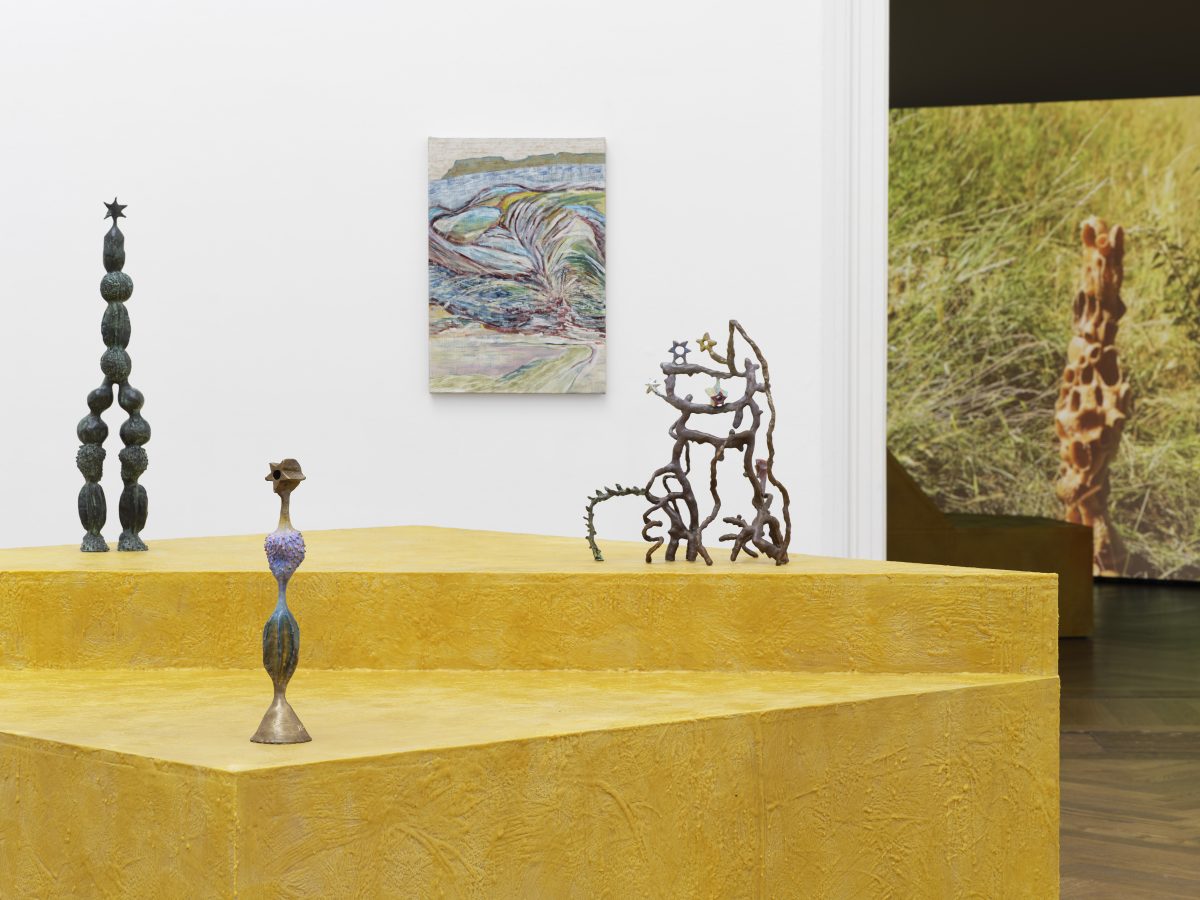
In Bees beings beans, Diambe begins with a seemingly pure and simple material: beeswax. However, in the artist’s hands, it turns into something else entirely. It softens, melts, resists, remembers. It presents a way to reflect on transformation, about how forms hold together or fall apart, and about the silent force of matter as it moves through time or across temperature scales. The exhibition, unfolding through sculpture, painting, and film, develops from early encounters with bees in Diambe’s São Paulo studio; what began as observation gave way to entanglement. Bees entered the space uninvited and stayed. Their presence introduced new rhythms of awareness and new questions: about the porousness between living systems and built environments and about how bodies gather, adapt, or refuse containment. The exhibition’s architecture follows the logic of a beehive. Sculptures rest on modular, honeycomb-like platforms. Visitors move among them, pause, and regroup, like a swarm responding to signals it doesn’t fully understand. In a central video, two beeswax sculptures are coated in sugar syrup and left in a field. A swarm arrives. Slowly, over time, the figures are hollowed out and collapse. What appears to be a ruin is simultaneously a testament to the emergence of something new. Surrounding these sculptural moments are paintings that fold in sacred landscape traditions. Seeds, market scraps, and traces of trade circulate across them, pointing to longer histories of movement, extraction, and survival. Bees beings beans does not attempt to explain these systems. The exhibition dwells in them, holding together matter and memory, climate and city, bodies, and the forces that shape them.
In Diambe’s exhibition, disappearance becomes a form of presence, signaling not absence but transformation. Here, Materials change: wax becomes bronze; softness gives way to solidity, and yet nothing settles. These are not simple material substitutions; rather, they are conceptual processes in which absence leaves a significant trace in tension, memory, and weight. The bronze sculptures hold that tension closely, reflecting the physical and temporal pressures that shaped them. Works such as Air quality (Qualidade do ar) and Honeycomb V (Colmeia V) (both 2025) appear not as complete or resolved objects but like remnants of something already shaped through past processes. Bronze, often associated with stability and monumentality, behaves differently here. Its surfaces bear traces of previous states such as heat, touch, collapse, and reformation. Rather than concluding a process, bronze becomes part of an ongoing transformation. These works invite us to look not just at what they represent, but at how a body or a form comes to hold itself together at all. Diambe’s sculptures emerge from a language that is both formal and deeply responsive. There are echoes of organic matter, human anatomy, and architectural fragments. While some shapes lean toward figuration, others dissolve into abstraction. The references to Brazilian Modernism, Neoconcrete art, vernacular architecture, and ecological forms are not illustrative; they are metabolized. They appear within the work as sediments reconfigured into a new visual grammar. Their motifs shift: a three-dimensional geometric form becomes a fruit, and a fruit becomes an animal. The animal, in turn, dissolves into a form that asserts itself without relying on recognizability. Within this fluidity, an ecological sensibility takes shape. An ongoing openness to change defines it. The Swarm as Work The space of the exhibition is central to how this way of thinking becomes perceptible. Created in collaboration with architect Gabriela de Matos, the exhibition’s architecture does not simply frame the works; it engages with them. Drawing on spatial languages from the Global South, de Matos introduces ideas of porosity, modularity, and reorientation. Sculptures are presented on platforms coated in beeswax that recall honeycomb structures or fragmented terrains. These surfaces support and redistribute the works, generating patterns of density and dispersal. No object stands alone; each piece contributes to a shared spatial rhythm, the movement of visitors, their pauses, and their paths, becoming part of the exhibition ’s structure. The relationship between viewer and work is shaped in part by the architecture itself.
This logic extends into the video Cera perdida|Lost wax (2025), which premieres in the exhibition. In the film, bees consume and transform two sugarcoated wax figural sculptures, and over time, the figures are hollowed out. What at first appears as a scene of disappearance becomes something else–a collaborative act of making. The film resists spectacle; it stays with the process, showing a form of labor that is shared, uncentered, and continuous. A swarm becomes a working model that is distributed, intelligent, and multiauthored. A constant, low humming sound runs through the exhibition for more than four hours, and it is not background noise but a condition of the space itself. This sonic presence intensifies the sense that change is not something that happens in isolated moments. The video establishes a dialogue between artist, material, and environment, revealing the interplay of dependency and responsiveness between human and nonhuman actors. Maps Without Legends The paintings offer a different rhythm. Painted with egg tempera, they register time through marks and surfaces. Each canvas becomes a terrain shaped by movement, particles, seeds, and residues. The imagery recalls maps without legends or surfaces where natural and social currents leave traces. Brushstrokes condense the colors of light, earth, and sky. These paintings do not capture distinct scenes; rather, they trace the cycle of memory, matter, and place. The city in the São Paulo series (all 2025) appears not as a singular entity but as a dense environment shaped by trade, weather, and bodies. Bees beings beans does not aim for resolution. The exhibition presents neither a static image of nature nor a straightforward critique of the urban environment. It moves with the logic of the swarm, with the drift of weather, with a duration that continues beyond the moment of viewing. What takes shape is not a narrative but a condition. It is a way of sensing that form is always shaped by labor, by environment, and by the material forces that pass through it.