
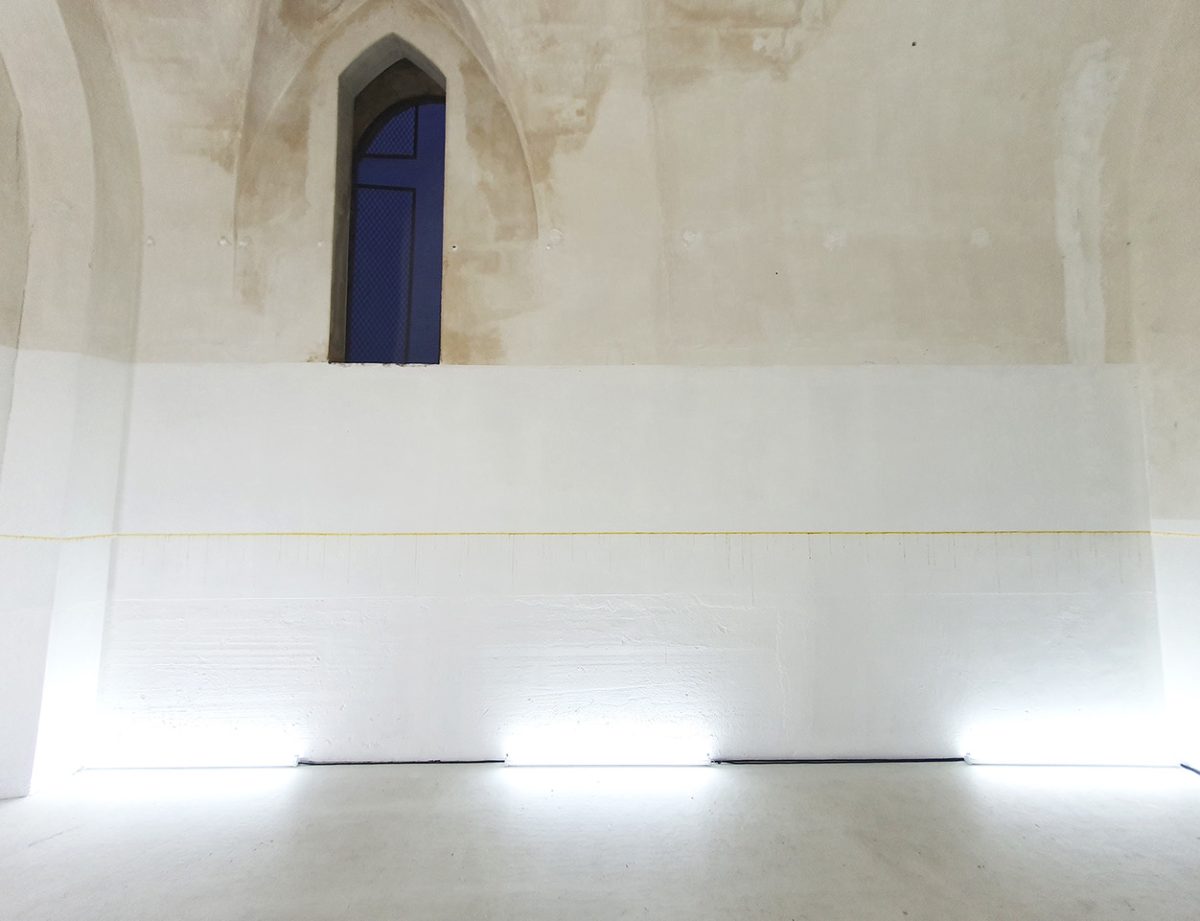
latifa echakhch | ferdinandea: portolano mediterraneo
On Saturday, June 27, from 6:30 PM, the SoutHeritage Foundation, with a renewed commitment to contemporary art and as part of “Matera Mediterranean Capital of Culture and Dialogue 2026,” presents the exhibition project: “FERDINANDEA: Mediterranean Portolan,” an exhibition that places contemporary art at the center of a reflection on the Mediterranean, understood not only as a geographical space, but also as a symbolic, historical, and cultural context.
In 2026, Matera in Italy and Tetouan in Morocco will be designated Mediterranean Capitals of Culture and Dialogue, recognized as symbolic cities of exchange, cooperation, and intercultural dialogue in the Mediterranean basin. Within this framework, the SoutHeritage Foundation for Contemporary Art, an institution driven by the desire to contribute to cultural development, to generate broader knowledge and consolidate artistic expressions in society by making them visible, relevant, and meaningful, is promoting the exhibition project “FERDINANDEA: Mediterranean Portolan.”
This second initiative in the SoutHeritage Foundation’s 2026 calendar, dedicated to the “Matera Mediterranean Capital of Culture and Dialogue 2026” program, was born with the aim of placing contemporary art at the center of a critical reflection on the Mediterranean, understood not only as a geographical space, but also as a symbolic, historical, and cultural sphere, traversed by relationships, conflicts, exchanges, and forms of coexistence, a constant yet evolving crossroads of peoples and languages, and therefore a fertile ground for growing social and cultural awareness.
The symbolic heart of the project, in relation to the theme of the Matera Capitale dossier entitled “Immersed Lands,” is the image of Ferdinandea Island: a volcanic island that emerged in 1831 in the Strait of Sicily and was destined to disappear beneath the surface of the Mediterranean within a few months. Before sinking, it was claimed and contested by various European powers, including Italy, France, and England (even in terms of its name: Ferdinandea for the Italians, Graham Island for the English, and Île Julia for the French). Thus, assuming Ferdinandea Island as a geographical apparition, a political construction, and a critical-symbolic figure of cultural appropriation and instability, the exhibition, conceived as a portolan (i.e., a map for orienting and navigating a territory), outlines—through the works of artists Latifa Echakhch, Philippe Favier, Marco Godinho, Bouchra Khalili, Runo Lagomarsino, Andrea Nolè, and Edi Rama—a vision of the contemporary Mediterranean not as a stable space or shared identity, but as a constantly negotiated territory. Far from a simple geographical vision, it emerges as a cultural and political device traversed by colonial and postcolonial, economic, and ecological fractures that continually redefine its boundaries and meanings. Like the island from which the exhibition takes its name, the Mediterranean is here understood as a place of emergence and immersion, where some stories or themes forcefully surface while others remain submerged or are actively repressed. The works on display are thus situated within this tension, presenting themselves as temporary forms of visibility and islands of meaning that question various aspects of the Mediterranean (from politics to economics, from migration to multiculturalism). The artists involved, hailing from diverse backgrounds yet connected to the Mediterranean, do not construct a unified narrative, but rather a polyphonic field of perspectives whose practices challenge any idea of a center, proposing instead a mobile geography, made up of crossings, dislocations, and multiple belongings. Within this framework, Ferdinandea represents not only a historical-symbolic reference, but also a method: a way of thinking about territory as something that appears and disappears, that escapes fixation and resists univocal definitions. The exhibition layout also seeks to reflect this condition, avoiding linearity and hierarchies in favor of fluid relationships, unstable juxtapositions, and the possibility of shifting meanings among the works on display. In fact, the Foundation, as part of its exhibition practices aimed at overcoming traditional ostensive formats to promote exhibitions as organizations of experiential contexts for the public, conceived the exhibition as a relational device that involved the installation of all the works at a deliberately out-of-scale viewing height,set 6 meters below the vault of the exhibition space. This measurement, measured below the ridge line of the ceiling and not above the ground, refers to the current bathymetric depth (-6 m from the surface of the Mediterranean) of the Ferdinandea Island evoked in the exhibition’s title. This depth establishes an invisible yet operative line, configuring itself as a perceptual orientation device that traverses the exhibition space and reconfigures it as an immersive environment. More than a simple symbolic reference, the -6-meter line acts as a “submerged depth” that displaces the usual regime of vision, subverting conventional anthropometric coordinates. In this way, the visitor is placed in a state of coincidence between their visual axis and the depth of the island, capable of experiencing a form of embodied identification in which the body becomes both a measure and, at the same time, an instrument of symbolic crossing. If Ferdinandea Island existed only for a brief moment, in the exhibition its image continues to persist as a trace and a hypothesis, revealing and symbolizing a Mediterranean not as a simple geographical area, but as a construction in progress, an open field in which the works act as intermittent signals, capable of making visible some of the tensions that run through it.