
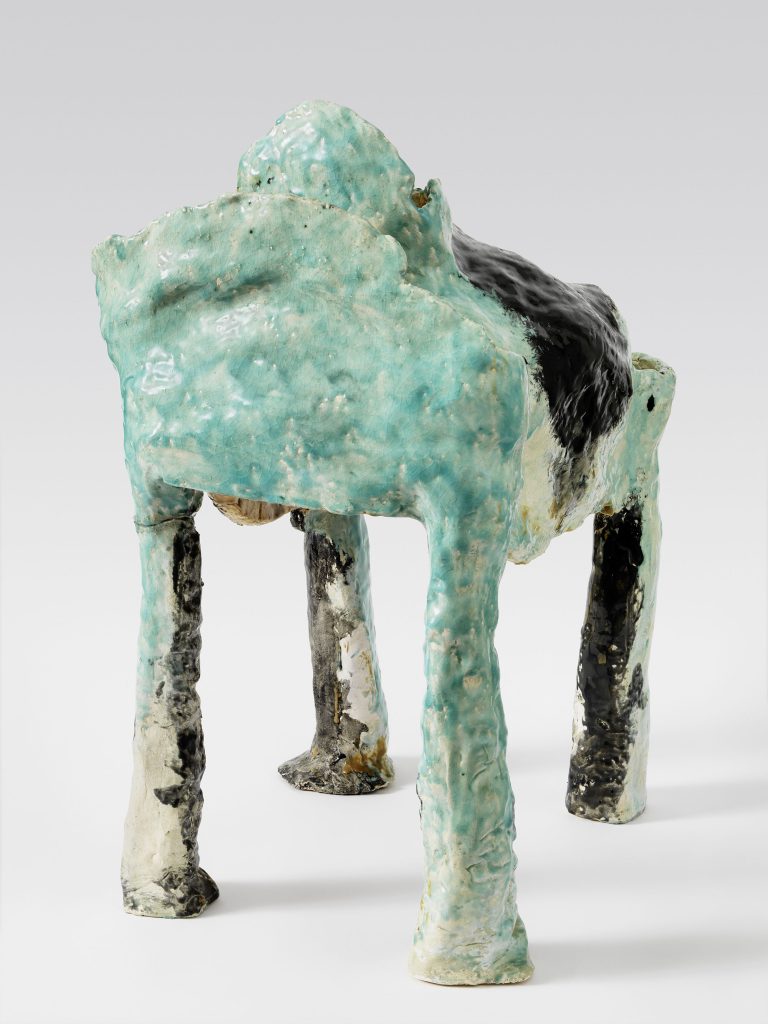
In the fall of 2026, the Musée d’Art Moderne de Paris will dedicate a major exhibition to Simone Fattal, a Lebanese-American artist born in 1942 in Damascus and living in Paris for many years.
Bringing together around one hundred works, the exhibition traces more than fifty years of his artistic journey, from his early landscape paintings to his ceramics and collages. Organized as a series of groups and outside of any chronological order, the exhibition invites visitors to explore the driving forces of a body of work that is diverse and constantly evolving.
Passionate about literature and archaeology, Simone Fattal first studied philosophy at the School of Letters in Beirut, then at the Sorbonne, completing her training with courses at the École du Louvre.
In the late 1960s, she began painting in Beirut, tirelessly depicting trees, the seafront, and mountains, pushing the boundaries of figurative art. In 1972, she met Etel Adnan (1925-2021), a Lebanese poet and painter, with whom she shared nearly fifty years of life and close friendship. In 1980, forced to leave Lebanon due to the civil war, Simone Fattal settled in Sausalito, California, north of San Francisco Bay. She temporarily abandoned painting to dedicate herself fully to founding The Post-Apollo Press (1982-2017), whose name was inspired by the Apollo space program, in which she saw the beginning of a new era in human history.
From 1988, she engaged in a ceramics practice after taking courses at the College of Marin and the San Francisco Art Institute. From the clay emerged archaic figures with anthropomorphic or animal lines that drew their inspiration from the mythological epics of the Mediterranean basin, mainly from Mesopotamia or ancient Greece, from the Epic of Gilgamesh to the Iliad and the Odyssey.
The 2010s marked the end of The Post-Apollo Press’s publishing venture and a definitive return to Paris. Alongside sculpture and the production of collages with intimate and collective narratives, landscape painting reappeared. Executed with bold strokes, colorful watercolors and black ink drawings with plant motifs conveyed his vision of nature animated by a boundless life force.
This first exhibition in a Parisian museum pays tribute to a major artist who is internationally recognized but has been little shown in France.
A catalogue developed in close collaboration with Simone Fattal accompanies the exhibition. Minimalist in its design, the monograph reproduces a wide selection of the works presented. Alongside the extensive iconography, it offers new texts, including a contribution by Penelope Curtis, former director of Tate Britain, as well as a text and biography by the artist herself. Blending critical rigor with an intimate perspective, this book illuminates the multifaceted creativity of Simone Fattal, visual artist, author, and editor.