
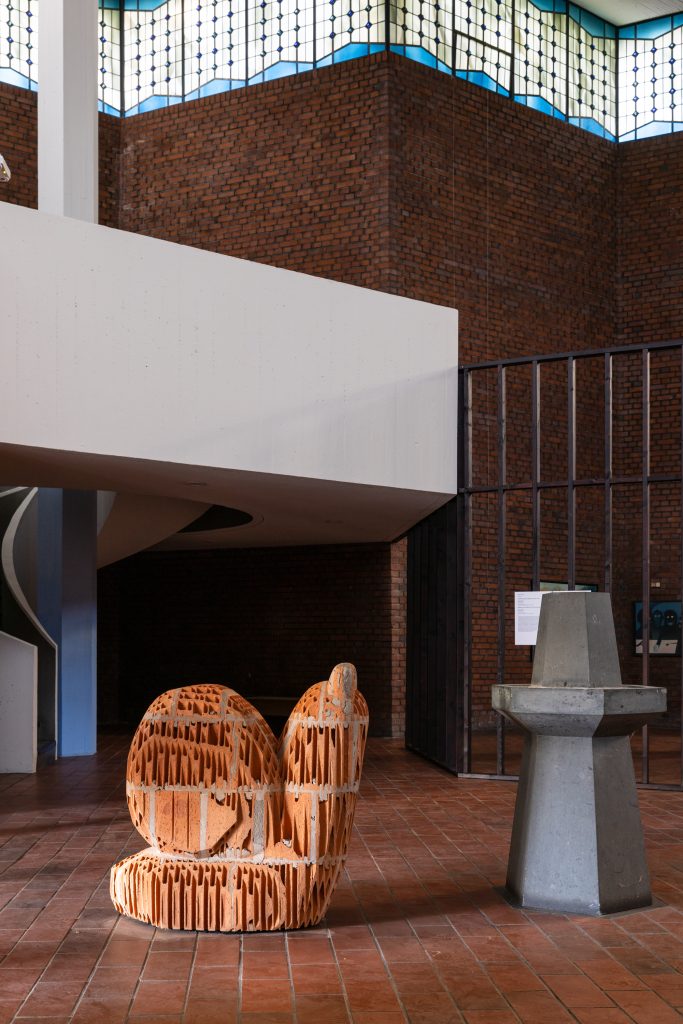
On the 21st of June 2026, Manifesta 16 Ruhr opens across four cities in Germany’s Ruhr Area, transforming twelve post-war church buildings into sites for contemporary art and architecture, social design and community encounter. Taking place during the European Nomadic Biennial’s 30th anniversary year, Manifesta 16 Ruhr asks a timely question: how can existing neighbourhood infrastructure be reimagined to support new forms of collective life in an era marked by social fragmentation, growing inequality and polarisation?
Developed through the biennial’s long-term pre-biennial research programme Urban Vision and Citizen Consultations, Manifesta 16 Ruhr is rooted in the proposition This is not a church. Rather than approaching vacant and under-used churches solely as architectural heritage, the biennial investigates how these spaces might become new civic anchors or tools to create more proximity in their neighbourhoods. In a region characterised by a polycentric urban structure and changing social realities, the project explores how culture can contribute to strengthening social cohesion, reclaiming public space and fostering proximity between citizens.
At a time when more than 20,000 churches across Germany are expected to become vacant or deconsecrated over the coming decade, Manifesta 16 Ruhr places the future of these buildings firmly on the national agenda. Through new artistic commissions, community-led initiatives and collaborative research, the biennial presents twelve examples of how former churches can be transformed into exhibition spaces, gardens, music halls, art schools, textile workshops, cultural centres and spaces for civic engagement. Alongside the main biennial, Manifesta 16+ extends this approach across the wider Ruhr Area through a programme of 16 grassroots initiatives transforming church buildings in six additional cities. These initiatives build on local knowledge and community-led practices. See the Annex for the full list.
Manifesta 16 Ruhr positions itself not simply as a platform for exhibition-making, but as an incubator of change and a transdisciplinary mechanism for urban and cultural reactivation. The biennial, and its programme, explores how the spatial legacies of industrialisation, modernity and institutional withdrawal can be repurposed for new forms of collective life. The Ruhr Area is understood here as a place of shared transformation, shaped by continuous processes of reinvention across its cities, communities and infrastructures. Thirty years after Manifesta’s founding in the aftermath of the Cold War, the biennial reflects on Europe as a space of encounter, solidarity and cultural cooperation at a moment when these values face renewed challenges.
Under the title This is not a church, the programme has been co-developed by an interdisciplinary team, composed of eight Creative Mediators: Josep Bohigas, Gürsoy Doğtaş and three intergenerational tandems from different countries — the British tandem Michael Kurtz & Henry Meyric Hughes, the German tandem René Block & Leonie Herweg, and the Polish tandem Krzystof Kosciuczuk & Anda Rottenberg. The model reflects Manifesta 16 Ruhr’s commitment to dialogue across generations and borders, responding firmly to contemporary European realities shaped by mistrust, misinformation and social division. Further insight into each tandem’s approach can be found in the Annex, which presents short complementary texts for each former church, situating each project within its building and surrounding neighbourhood context.
Manifesta 16 Ruhr will present a significant number of newly commissioned works, with 67 new commissions and a total participant list of 107 (see the Annex for the full list). Participants from more than 25 countries will contribute to the programme, with Germany, Poland and Turkey among the most strongly represented reflecting the Ruhr Area’s complex histories of migration.
Manifesta 16 Ruhr lasts for fifteen weeks until the 4th of October 2026. It is entirely free to visit all the twelve venues as well as a lively programme of events, workshops, family activities and walks