
lily van der stokker on artforum | male art: lily van der stokker spoofs the manosphere
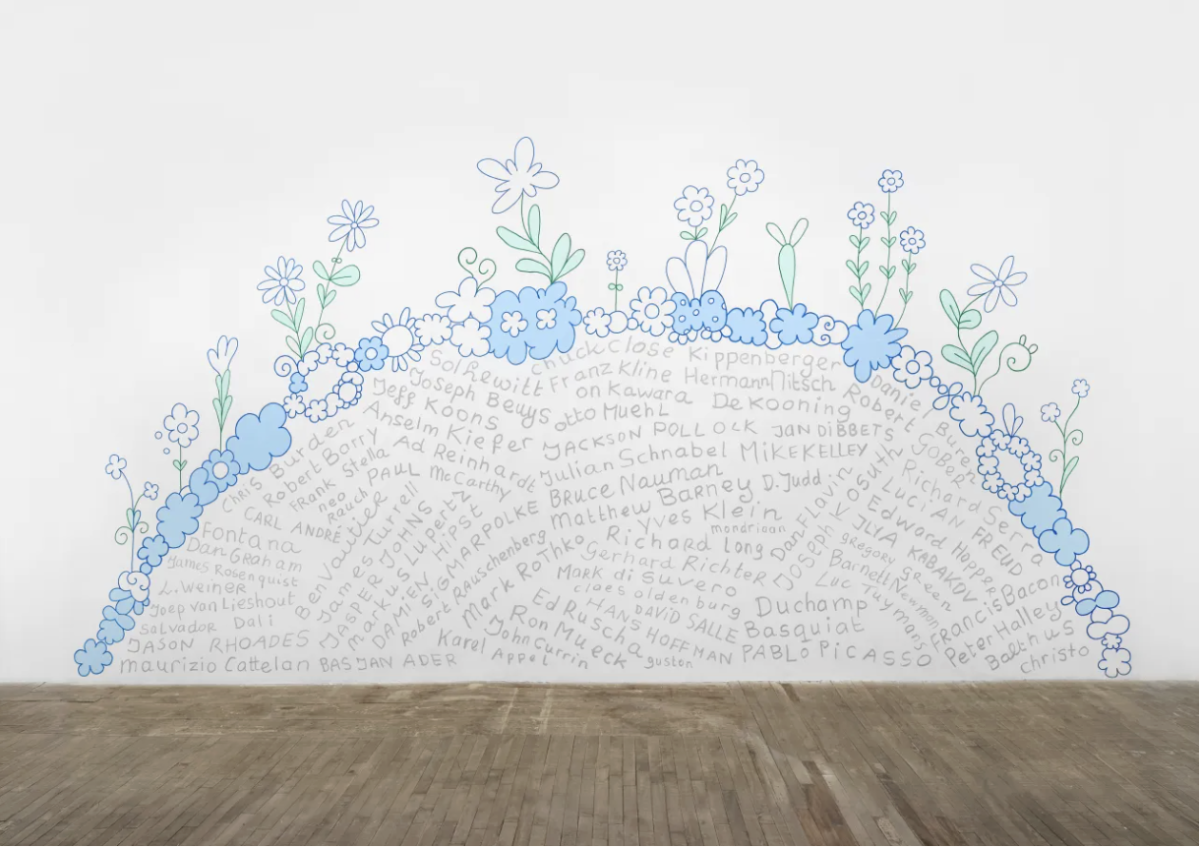
Through August 8, 2026—A monumental, double-edged valentine to modernism reads MONDRIAN: BOYISH ART WITH RECTANGLES, painted directly on the wall in gray, bubbly longhand encased in a doily-esque cloud. On the opposite wall, a heap of jumbled names belonging to famous male artists takes the shape of an ancient burial mound—a flowering necropolis of dudes. A layer of vegetation sprouting from its surface suggests that the things we pronounce dead are still active agents in the world of the living.
These wall drawings are part of Lily van der Stokker’s “Male Art Exhibition, Great Show!,” presented at kaufmann repetto. Its exclamatory title alludes to a fantasy presentation drummed up by the artist in response to the all-male art exhibitions that dominate art history. Such gatherings are considered neutral and rarely assessed for possessing a possible male temperament; whereas an all-female show is decidedly women’s art. In an essay, Mondrian once referred to his pert rectangles as “aesthetically purified,” as a “pure representation of the human mind.” In calling the De Stijl artist’s rectangles boyish, van der Stokker pokes at the rigidity of Minimalism’s hard geometry.
Serving as a historical anchor for the exhibition is a 1994 letter that van der Stokker wrote to curator Leontine Coelewij, printed and framed as an artwork. In it, the artist references her failed proposal to curate an all-male exhibition: I SEE THE FEAR OF THE POWER OF A CULTURE IDEAL STRUCTURED BY MEN THAT IS UNIVERSAL AND SEXLESS. EMANCIPATION DOES NOT MEAN ‘BEING EQUAL’ TO MEN FOR ME (AS SIMONE DE BEAUVOIR), BUT BEING ABLE TO BE ‘DIFFERENT’, AND WITHIN THAT BEING TAKEN SERIOUSLY (= EQUAL TREATMENT). THE CLICHÉ IS THEREFORE A SUPPORT FOR ME. IT IS THE MATERIAL I WORK WITH TO INVESTIGATE DIFFERENCE. Her feminized presentation of masculinity troubles the exhausted masculine-feminine dichotomy. On the adjacent wall is a small painting rendered in exuberant, candy-coated handwriting that references the current show “Beyond the Manosphere – Masculinities Today,” at the Stedelijk Museum in Amsterdam. That exhibition shares the aims of van der Stokker’s aforementioned proposal: a broad presentation of masculinity that explores a more nuanced range of male subjectivity, one that leaves room for a femininity with equal footing.
The drawing Machismo Top Ten (in Blue), 2026, indexes a list of male artists accompanied by quippy annotations outlined in whimsical curlicues, reminiscent of graffiti scribbled in a bathroom stall or a list of secret crushes one would be mortified to have anyone discover. The list includes ANSELM KIEFER (BIG!), RICHARD SERRA (BIGGER), JEFF KOONS (SO TIDY), DAMIEN HIRST, JULIAN SCHNABEL (MONEY), CHRIS BURDEN (KILL-SHOOT), and so on. But what is it about this particular group of frat-boy, big-dick artists assembled by van der Stokker that feels so hyper-masculine? Is it the work’s excessive scale? Its alternately sleek or roughshod production? Its reckless and sometimes violent nature? Its market success? What these practices share is a sense of freedom reserved for white men whose identity, despite weird or macho antics, is always stable. All of this is complicated by the fact that some of this dude art is crush-worthy and that boyish carries a certain charm that girlish hopelessly evades. Critics, myself included, have been quick to call van der Stokker’s art girlish—by which we mean a little cutesy, a little superficial. And yet, alongside Burden’s white-knuckle performances, let’s consider his Metropolis II, 2011, which is composed of toy trains and cars, a Hot Wheels set with high production value.
In the gallery downstairs, a wall of black-and-white canvases resembling a cluster of protest signs signals a departure from the artist’s iconic pastel palette. One placard is emblazoned with a direct quote from Bas Jan Ader, van der Stokker’s fellow countryman and one of her all-time favorite artists: (MY HERO) BAS JAN ADER: “WOMEN WITH BIG TITS MUST BE INTELLIGENT.” Van der Stokker presents the conundrum of appreciating work made by someone capable of being a misogynistic asshole. The achromatic quality of these works feels like a metaphor for the binary, black-and-white thinking that plagues the culture wars. The exhibition brings to mind the “masculinity crisis” and the red-pilled plight of the manosphere. What I enjoy most is how this exhibition delights and unsettles me—thwarting my desire to know exactly what van der Stokker is laughing at: masculinity, feminism, or her own antics. Most likely, all of the above.