
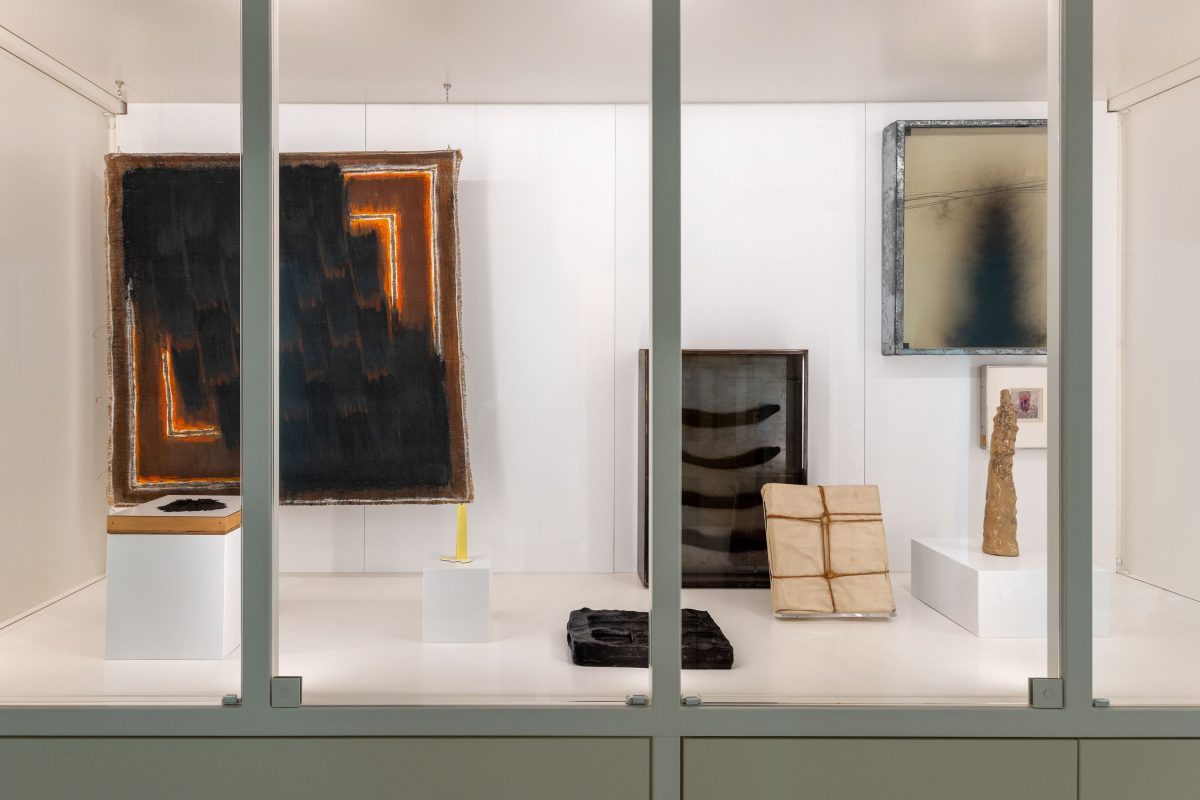
The Irene Y. Panagopoulos Collection, opens its second exhibition, Everything I Know Is a Borrowed Map, curated by Akis Kokkinos. The exhibition explores the act of collecting as a vehicle to understand whose stories are preserved, whose are on view, and whose are in storage. Questioning inherited systems of classification and the hierarchies imposed by dominant ideologies, this exhibition suggests new liberated ways of approaching knowledge and interpreting the world.
Investigating the tools and methods of museological practices, the exhibition challenges the norms that control how objects, human artifacts and nature’s creations are classified, categorized, and displayed. Through the vitrines and storage grids, these systems shape our perception of history while simultaneously limiting it within fixed dimensions of space and time.
Encased in glass resembling an aquarium, the exhibition is transformed into a vessel that controls and preserves the collection. At the same time, it invokes the aquarium’s condition of constant movement, activating a dynamic ecosystem in which the viewer becomes an active participant. Roles shift, objects become subjects, and storytelling expands beyond imposed boundaries. In this space, visitors are invited to question, erase and rewrite their own “maps” through engagement with the Irene Y. Panagopoulos Collection.
Bringing together a wide range of materials, from archives and historic maps to works by leading Greek and international artists, the exhibition unfolds across six sections called Marginalia.
Note: Marginalia, the supporting information printed along the edges (the margins) of a map, has evolved into a key navigational element for this exhibition.
Marginalia I: Setting the scene and attributing a performative character to the exhibition, the first section functions simultaneously as a gate and a barrier, commenting on the cartographies of power and border-control systems.
Marginalia II: Archival materials, redeveloped constructions and artworks shaped by nature’s elements, intuition and metaphysics, introduce questions of gender power and emotional accumulated experience that bring into conflict institutional frameworks and fragile forms of knowledge.
Marginalia III: The exhibition is transformed into a performative act highlighting the importance of storage and preservation within the collection’s context. Following the trajectory of the grids, issues of queerness, feminism, race and censorship come to the spotlight whenever “their grid is pulled out”.
Marginalia IV: A combination of different artworks and archival materials presented in different ways puts in focus issues of geography, territory, political power, knowledge construction and their effects on human lives.
Marginalia V: A corpus of artworks created by female artists explore ways of using the human body as an instrument of resistance to imposed patterns of control.
Marginalia VI: Rare archival materials, selected artists’ publications, sound works, and sculptural installations reframe the space as a living ecosystem, inviting the audience to step into the unknown and observe the world through the vitrines we inhabit.